Run a tighter business.
Get your evenings back.
I build automation systems for the parts of your business that don't need you. Quoting, scheduling, invoicing, follow up, all the admin underneath. So you stop doing it yourself at 9pm.
Who this is for
You built your business around your passion and skills.
The admin and operations work behind that, the small stuff that piles up after hours, does not need to stay on your plate. The right systems handle it faster, more reliably, and with fewer things falling through.
Customers move fast now. They expect a quick response, and the next business is only a click away. A good system catches the request, replies with the right next step, and keeps them engaged and moving forward with your business instead of moving on to your competitor.
- The Saturday call that goes cold by Monday.01
- The quote that was supposed to go out yesterday.02
- The follow up you meant to do three weeks ago.03
- The invoice you keep forgetting to send.04
The Work
Most of what I build follows the work as it moves through your business, from the first request to the final payment. Each handoff can have a system behind it. You don't need all of them. Most businesses start with one or two. Pricing for the systems below is sized to your business and confirmed during the workflow audit.
The Workflow Audit
I look at how your business actually runs day to day, from first request to final payment. We expose the three to five biggest fixes and talk through how to implement them. No subscription, no commitment, just useful information.
Quote Engine
We build a simple intake that customers can fill out from wherever they find you (phone, website, social, referrals). The system turns that information into a finished quote you can review, adjust if needed, and send with confidence.
Follow Up Loop
When a quote goes out and the customer goes quiet, this picks the conversation back up. Polite reminders when quotes go stale, nudges that don't sound robotic, and a simple dashboard so you can see where each warm opportunity stands.
Schedule Builder
Once work is booked, it goes straight into the calendar. The system coordinates the people, dates, reminders, and customer details, without you doing all the planning and legwork.
Invoice Loop
When work wraps, the invoice sends itself. Payment reminders and staff payroll invoices can be generated from the same clean records, so you know who owes what and you stop chasing money.
Custom Systems
Some of the best systems start with a two-minute task you hate doing every day. If it is repeatable, we can usually build a way for it to happen, get tracked, and stay visible without you doing the mundane work yourself.
How it works
We talk for 15 minutes.
No pitch. I ask about your daily tasks, big and small, and how your current systems work. We uncover what's quietly leaking and where the easy wins are. If there's nothing worth fixing, I'll tell you.
We proceed with the audit.
It can take a week or two, but we dissect your current workflows and create a plan of what to fix, in what order, and what each fix costs. Most owners spot at least three places they're losing time before we build anything.
We build the systems.
Quotes, follow ups, scheduling, invoicing. The things you find yourself doing after dinner or on weekends. One by one, they stop being your job.
You get your evenings back.
No retainer, no monthly minimum. The business runs without needing you to chase it. You spend your time on the work only you can do.
System examples
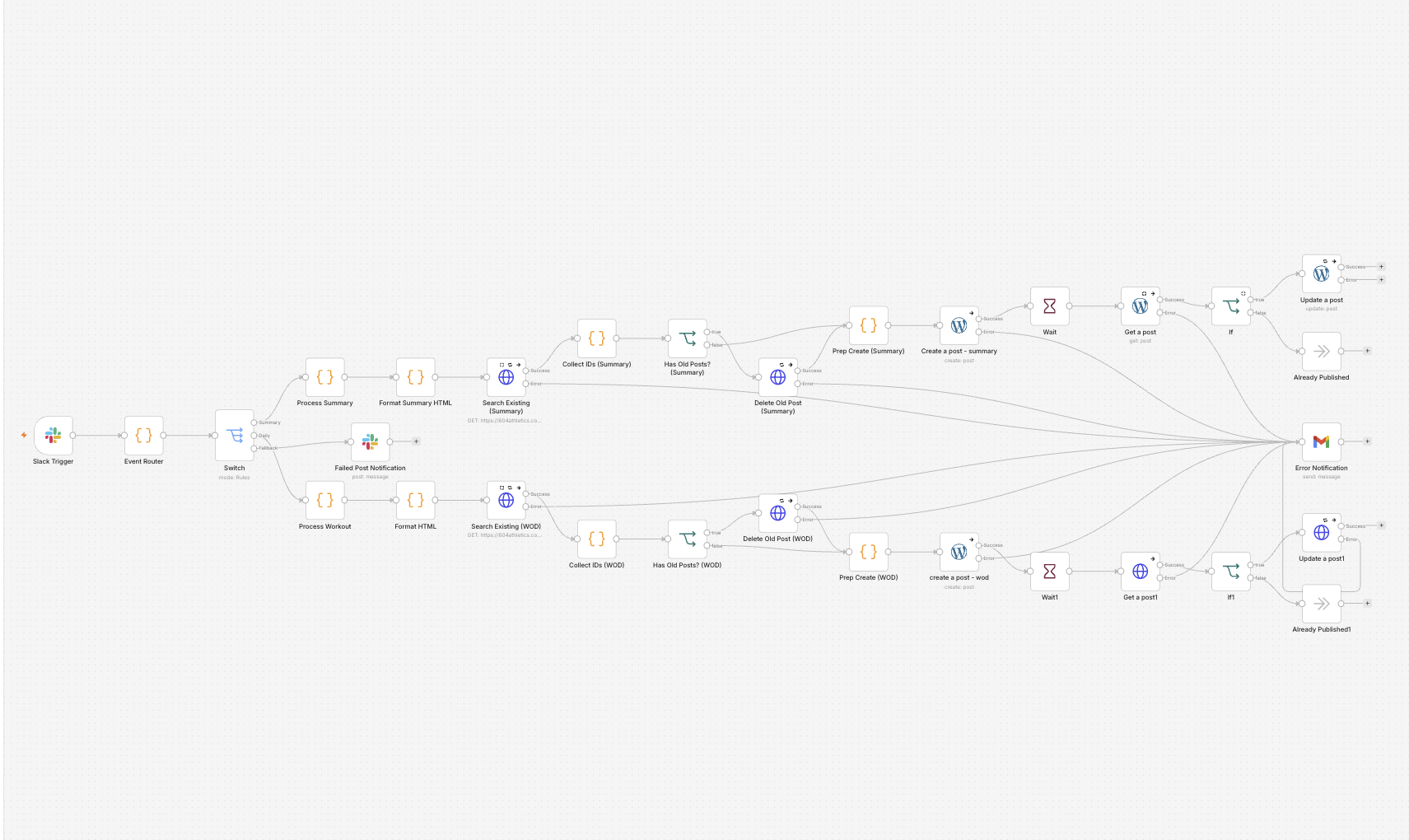
Note: these screenshots use example data to protect client privacy. No real customer, client, or pay information is shown.
A simple, repeatable task that only took a few minutes a day, but still had to be remembered, checked, and finished by hand.
The Problem
Every single day, I had to publish a blog post on my WordPress site. I wasn't even writing the content. I just had to copy it from a Slack message, format it, log into the site, build the post, and schedule it for 5pm. Then came the part I really hated: hoping it actually published. WordPress is notorious for failing silently, and when it did, I had to drop whatever I was doing and fix it from my phone, wherever I was, whoever I was with.
The task itself wasn't huge. Maybe 60 minutes a week. But it was relentless, and it owned a piece of my evening every single day.
The System
I built a workflow triggered by the Slack message itself. It grabs the content, formats it for the site, schedules the post for 5pm on the right date, and then at 5:01pm verifies the post is actually live. If WordPress dropped the ball, the system publishes it on the spot.
I no longer touch this task. Ever.
What That Looks Like in Practice
- The exact trigger that starts the task is identified and captured automatically.
- A small workflow handles the repeatable steps end to end.
- A visible record confirms the post is live, so nothing has to be hunted down.
- I stay in control of what gets published, without having to do the mundane part.
The time savings are real, but that's not the point. The point is I don't step away from the dinner table anymore because WordPress decided to misbehave.

For almost fifteen years, the business software we rely on to run the gym tied our hands in ways that quietly cost us money and sanity every single week.
The Problem
Two problems, deeply tangled together.
The first was the coaches' schedule. We offer a lot of services, but the booking software forced us into a rigid schedule that never reflected what we actually had available. Managing it manually was brutal. Doing it inside the software was worse. So every single week, we piecemealed it together by hand.
The second problem was invoicing. We had to rely on coaches to tell us what they were owed and for what. We built spreadsheets, we built systems, but in the end someone had to manually audit every invoice to make sure it was right. And the rules were not simple.
A small example: we pay our coaches to show up 15 minutes early, regardless of when their shift starts. Anyone closing on a weekday gets an extra 15 minutes paid, but not on weekends, because weekend shifts always end on an Open Gym slot. Then layer on specialty events, nutrition challenges, private training, bonuses for closing new prospects, and a dozen other variables.
Every pay period was a ball of spaghetti we had to untangle by hand.
The System
We couldn't replace the business software. Every financial transaction and product runs through it. So instead, I built around it.
Using the API and some email triggers, I pulled the entire schedule into our own database. From there, I built an add-on platform that tracks every minute and every dollar a coach works under our roof.
Layered on top of that:
- A notification system so coaches always know their schedule.
- A way for coaches to enter away dates well in advance.
- A "perfect week" template the manager can pull from to build each week's schedule.
- Logic that factors in who is available, who is qualified for which service, and a seniority tracker that ensures the right coaches get the hours first.
At the end of every pay period, I get an invoice presented to me. I click approve. The coach gets a copy to sign off on, and the bookkeeper gets a copy dropped straight into the right Dropbox folder.
What That Looks Like in Practice
- The schedule reflects reality, not whatever the booking software felt like allowing.
- Coaches always know where they stand, and away dates stop being a surprise.
- Every minute worked, every dollar owed, and every bonus earned is tracked automatically.
- Invoices are correct by default. No more audits, no more spreadsheets, no more guessing.
- My manager spends a fraction of the time on the schedule, and I spend almost none.
This one is more complex than most of what I build, but the savings in correct invoicing alone are worth their weight in gold. The real win is everything around it: a schedule that finally reflects the business, a manager who isn't drowning in admin, and coaches who trust that what shows up on their invoice is right.
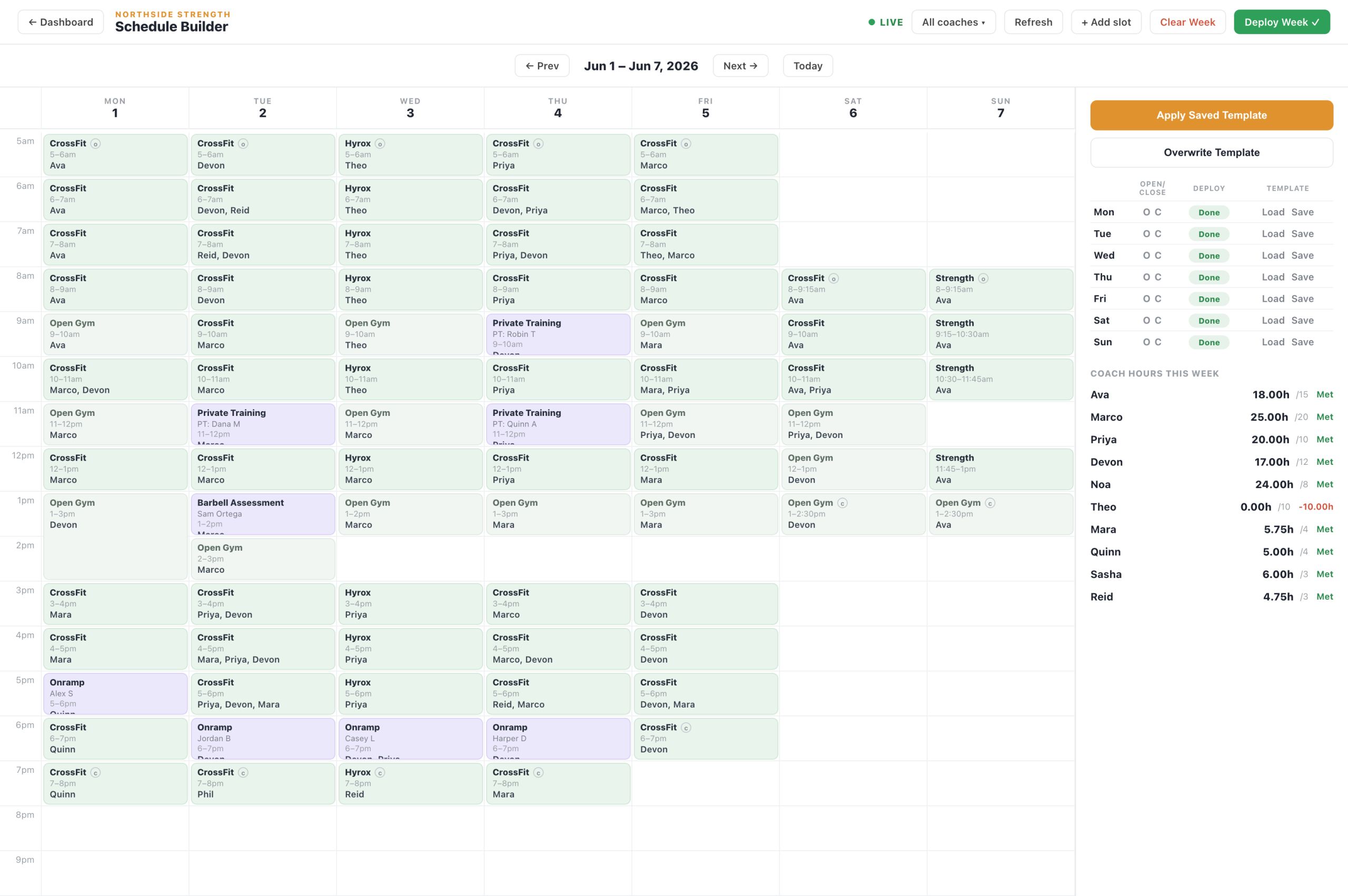

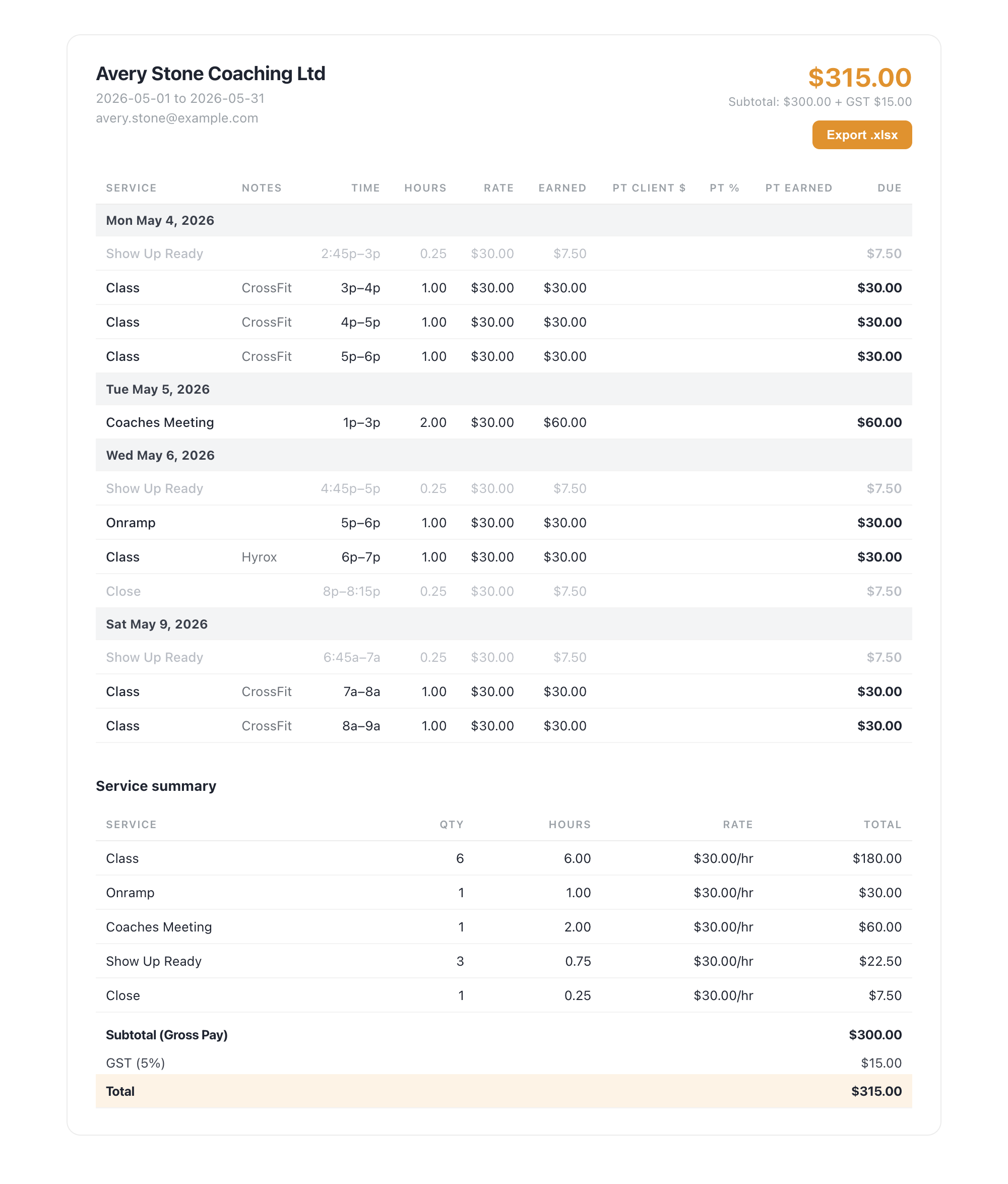
Example data. No real coach names or pay information is shown.
A client of mine sells high-end products entirely through social media. The work is real, but the rhythm of it is brutal.
The Problem
She runs international ads, which means DMs come in at every hour of the day. Each prospect moves through stages: lead, course, purchase. Each conversation is at a different point, with a different tone, and a different next step.
The posture she takes is consistent. The questions she asks are consistent. The way she guides a prospect from curiosity to course to purchase is consistent. But she's one person, and a steady stream of conversations across every time zone is not a one-person job.
She didn't want a chatbot. She wanted something that felt like her. Something authentic enough that the prospect never feels like they're being processed, doing 99% of the work for her without giving up the part that makes it work in the first place: her voice.
The System
I built a system that pulls every DM from her social inbox, vets the prospect, and starts the conversation. It drops conversational breadcrumbs that move the prospect through her funnel from first message to purchase, in her voice, at her pace.
The part she loves most is the control. She can run it fully automated, or she can keep a finger on every single message. It all flows through a Slack channel on her phone:
- A prospect's message comes in.
- A reply is already drafted, in her voice, ready to go.
- She taps "send" or "edit" if she wants to tweak it.
That's it.
Underneath the surface, the system is doing the real work. It carefully funnels each prospect toward their pain point, identifies how the product fits their life, and quietly filters out the messages that were never going to convert. At the end of every day, she gets a snapshot of her lead funnel on her phone so she knows exactly where every prospect stands without digging.
What That Looks Like in Practice
- Every DM is captured, sorted, and responded to without her having to be online.
- Replies are drafted in her voice, ready to send with a tap.
- She decides how much control she wants: full autopilot or final say on every message.
- Prospects that aren't a fit are filtered out before they eat up her time.
- A daily report tells her where every lead sits in the funnel, at a glance.
The result is a business that keeps selling while she sleeps, without ever feeling automated to the person on the other end. She still owns every conversation. She just doesn't have to type every word.

Example data. No real prospect names or messages are shown.
Every business with inbound interest leaks leads. Inquiries arrive at all hours, get a slow reply or none, and quietly go cold. This system makes sure that stops happening.
The Problem
Inquiries came in from everywhere. The website, Instagram DMs, drop-in forms, referrals, at every hour of the day. Whoever was working would try to answer between everything else, but a lot slipped through. A message at 9pm on a Saturday might not get a reply until Monday, and by then the person had already signed up somewhere else.
We were paying for ads to generate those leads, and then losing them to a slow inbox. Nobody could tell you, at a glance, how many warm prospects were sitting there waiting to hear back.
The System
I built a lead engine that pulls every inquiry into one pipeline, no matter where it came from. The moment a lead lands, the system reads it, sorts it by what they want, and drafts a reply in our voice.
That draft drops into a Slack channel with a short countdown. If no one touches it, it sends on its own. If someone wants to adjust it, they tap edit. Either way the lead hears back in minutes, not days.
- Every lead lands on one board and moves through clear stages: new, active, drip, stale, converted.
- Quiet leads get polite, human-sounding follow-ups on a drip, instead of being forgotten.
- Everything syncs to our member software, so we can see who actually walked in the door.
- The whole thing runs on pennies a day in AI cost.
What That Looks Like in Practice
- Every inquiry, from every channel, gets a reply within minutes, day or night.
- Replies are drafted in our voice and either send automatically or wait for a quick human edit.
- A single board shows exactly where every prospect stands, and which ones need attention.
- We stopped leaking the leads we were already paying to bring in.
The inbox went from a source of guilt to something that quietly runs itself. We still decide who we take on. We just stopped losing people to a slow reply.


Example data. No real lead names, contact details, or messages are shown.
About Jason

Entrepreneur and owner operator of multiple small businesses for decades.
I know how an operator-led business actually runs. The texts at 9pm. The boring admin work that you or your spouse keep meaning to get to. The small stuff that quietly steals your time and eventually eats into your evenings. Invoicing, payroll, equipment servicing. All of it.
My role at the CrossFit gym I own had become a pile of tiny tasks. Each task was only a few minutes, but the cost was mind-blowing once I added it up. So I built systems to take that work off my plate. The jobs got done cleaner than I'd ever managed myself.
Now I build systems for other owner-operated businesses. Systems should handle the work that doesn't need you. Your time goes to the work only you can do, and the business stops following you home.
Depth
Different work. Same pattern.
I have spent most of my life figuring out how things work.
Music tours, photography, reef tanks, CrossFit gyms, online gaming systems, web design, music production, custom applications, heavy equipment. Different worlds, same pattern: learn the moving parts, find the bottlenecks, build a cleaner way through.
That is the lens I bring to small-business systems. The software matters, but only if it fits the people, the timing, the mess, the budget, and the way the work actually gets done.









Get in touch
Message received.
Thanks for reaching out. I'll reply within a business day, usually faster.